Daphne du Maurier, when interviewed strongly denied that she was a romantic novelist, in spite of writing “Rebecca” and “Frenchman’s Creek”. I would agree with her evidenced by her powerful short stories. In fact, she had a deep psychological insight into human passion, guilt and sin.
A number of her earliest stories are collected in “The Doll” published by Virago (2011). Du Maurier inherited the lampooning spirit of her French paternal grandfather, the cartoonist of Punch Magazine but she was certainly no caricaturist. For me, one story stands out in this collection, written in her early twenties.
It is an unpolished masterpiece of some depth. “And Now to God the Father” is a pen portrait of a vicar, Revd James Hollaway, whose name sums up his superficiality. The story opens with the vicar admiring his own good looks in a mirror. It quickly moves to the adoring women in his congregation, whom he sees as “tools of his ambition”. They are only too willing to believe in his inner goodness. It soon becomes clear that what he is really is, is an actor with a very sonorous voice. His strong appeal to females is his single status which, together with his role, enables him to mix freely with the people of his choice, who are famous actresses and titled women, in theatrical high society.
This characterization could appear, at first, to be just anti-clerical and feminist, a devastating analysis of the Establishment's networks of amoral power, fed by “little" people, such as the adoring often unattached women who psychologically "latch on" to vicars.
Rev James Hollaway is Anglo Catholic, an Anglican vicar of Catholic tastes, who leads the imaginary St Swithen’s in Upper Chesham Street. His church sounds rather like an Anglo Catholic high society church, probably in Chelsea during the 1920s. Du Maurier describes its “drugged atmosphere” created by “heavy-scented flowers and waves of incense”, by the organ with its “deep, sensuous throbs”, by vestments and by boys “in red”.
The Mass is “a drama” in which the Vicar is “the main actor”. She writes “The choir and organ serve only as complements to his own voice”. The vicar is “tall and broad shouldered" with "a straight nose and magnificent iron grey hair”. His added appeal is that he does not talk religion, except with “the intense” (on Thursday evening). Like the rich, he attends the theatre in the company of wealthy ladies of leisure. He is a very worldly man. Of course, her scathing portrait could apply to any other strands (liberal, evangelical, charismatic) in the Anglican, or any other church, today. It could indeed still apply in some churches in London. There have been London vicars with a following who will “probably be a Bishop”, who when they disrobe, go out to celebrity parties or home to a multi-million pound London mansion. This phenomenon was certainly in existence before post-modernism undermined class and snobbery, but it still exists, no doubt in other forms, whenever the flock become “tools of ambition”, manipulated by religious leaders for their own ends. It is a phenomenon of cults.
Du Maurier brilliantly goes deeper and further. A titled young man privately asks Rev Hollaway to intervene with a young, innocent woman without money whom he has got pregnant and who is asking him to marry her. Rev Hollaway does this, but with naked sadism, entirely without concern for the woman. He brands the pregnancy as her fault (for having anything to do without someone not in her class). Then he suggests that she got pregnant merely to snare a wealthy man. He offers to arrange to have the baby adopted and to send her to India, to work alongside a female missionary. In fact, looking back, in the 1920s when pregnant women were put away in psychiatric homes for life, this was not the worst that could have happened to her! When he reads in the newspaper the next day about her suicide, he is more concerned about another article, attacking society women who “do nothing”.
Rev Hollaway is a dangerous sham, since, due to his clerical role, he gains the trust of those who should look elsewhere for genuine help. This could be a feminist story, but Du Maurier instinctively pierces to the heart of the problem, which is Rev Hollaway’s inadequate understanding of sin. WE are told that after 'solving' the issue of the pregnant woman, Rev Hollaway kneels at his bedside to acknowledge to God his sins of the day. Clearly, his handling of the vulnerable woman is not one of them, since he has no guilt or conscience when he reads about her death.
The dark du Maurier vision is that of a vain man, brought up to say his prayers and confess sins at a superficial level, tended by gullible women, whom he manipulates for his own ends, who uses religion as his medium for a comfortable income, and his own pleasure. However, in feeding his own vanity (the flesh) his kills his soul, the soul in which his conscience resides. He becomes an agent of evil, in spite of his external respectability rather like the New Testament Pharisees who sought to kill Jesus.
This story is an insight into what the Bible teaches about God “hardening the heart” as his punishment on habitual sin. It is also a parable about gaining the whole world and losing one’s soul. Young Du Maurier strongly condemns both the complacent rich and the silliness of adoring and gullible women which helps to create men of vanity.
From my viewpoint, the ultimate evil is the quenching of true Christianity in the church and elsewhere.
Saturday, 28 December 2013

Friday, 27 December 2013
Making homemade Christmas presents
Making Christmas presents by hand is excellent for developing one's skills. One steps out of a routine to create. As with the exercise of putting men on the moon, creative spin-offs from Christmas must be endless. But is it worth it?

When it comes to Christmas presents, it is hard to make anything convincing. Some people react as if they should not equally value a handmade gift, when in fact they should value it more, as it comes with personal thought, and time. Making chocolate truffles is a nice Christmas gift, but there are those who are fastidious about food hygiene who may not be impressed!
This year, I spotted something for female family and friends, in early December. I noted a shop fashion for fur headbands, marketing at around £14 each. They seemed simple to make so I tried making a prototype. It did not wash well. I found that some brands of cheaper fur mats up, when washed.
I narrowed the choice of fur to something thicker. Before finally selecting a fur, I tested it by washing it and it came out unscathed. So I made thirty individual pieces, while watching TV in the evenings after work. It took me two weeks, as I work full-time. Happily, I enjoy creating things with a needle.
The furry mobile phone holder (left) seemed the most novel and was given to a nine year old. I am delighted that one relative is wearing her headband and scarf for New Year Fireworks at Edinburgh Castle.
I have christened my fur range "Interglacial Wear".

When it comes to Christmas presents, it is hard to make anything convincing. Some people react as if they should not equally value a handmade gift, when in fact they should value it more, as it comes with personal thought, and time. Making chocolate truffles is a nice Christmas gift, but there are those who are fastidious about food hygiene who may not be impressed!
This year, I spotted something for female family and friends, in early December. I noted a shop fashion for fur headbands, marketing at around £14 each. They seemed simple to make so I tried making a prototype. It did not wash well. I found that some brands of cheaper fur mats up, when washed.
I narrowed the choice of fur to something thicker. Before finally selecting a fur, I tested it by washing it and it came out unscathed. So I made thirty individual pieces, while watching TV in the evenings after work. It took me two weeks, as I work full-time. Happily, I enjoy creating things with a needle.
The furry mobile phone holder (left) seemed the most novel and was given to a nine year old. I am delighted that one relative is wearing her headband and scarf for New Year Fireworks at Edinburgh Castle.
I have christened my fur range "Interglacial Wear".
Boxing Day lunch in John Evelyn's Library
I chanced upon this delightful place, Wotton House, during October, while attending a conference about wood in the south of England. I heard a lot of stuff about "methane-producing rotting logs" lying around. We have a lot of rotting wood in the south east, in private woods, which could be harvested for fuel to keep people in rural areas warm. Clearing woods of many trees is good for wildlife. RSPB, the society for the protection of birds, were key contributors since woodlands which are less dense and lighter are more fertile, offering more insects to birds.
 Wotton House with the Evelyn Library (photo from Wikipedia)
I was also bowled over by the venue, a large country house near Dorking, Surrey, Wotton House, and its good food which I thought would be lovely at Christmas. The price was excellent: £35 a head for hot and cold Christmas buffet (as much as one could eat).
I had no idea, until yesterday, that Wotton House was once the home of John Evelyn, the English 17th diarist, writer, tree expert and gardener. His descendants still own the house, now a hotel. The Queen in her Christmas message spoke about keeping a diary to create a "private space" for meditation on life during the year, taking time out from over activity. I did this all last year for the first time. Keeping a diary helps make sense of life's fragmentation and gives one a sense of balance. It is also useful for knowing exactly when things happened, such as when library books were taken out of the library, if you lose track!
John Evelyn was an English "diarist" like Samuel Pepys whose diary also covered The Great Fire of London in 1666. Evelyn started his diary around 1640 describing his Grand Tour, then offering insights into life under Charles 1st. It is beautifully written.
Evelyn was also a keen gardener and planted out the garden of Sayes Court in Deptford, London, part of which still exists as a run down, municipal garden. He created the garden at Wotton House which he inherited, when his brother died childless. The Italian garden was famous. Evelyn was also a keen supporter of the planting of trees for the building of ships of the Royal Navy, so it was quite appropriate that a conference about trees should take place there. Evelyn particularly loved fruit trees. He wrote about numerous subjects, including theology and had an enormous library, as a lover of books, a keen bibliophile. Below is a photo of the Evelyn library decorated for Christmas.
Here is the online Diary of John Evelyn which begins "I was born at Wotton...." His diary includes wonderful descriptions of Rome and Venice and crossing the Alps from Piedmont to Brig during the 1640s.

I was also bowled over by the venue, a large country house near Dorking, Surrey, Wotton House, and its good food which I thought would be lovely at Christmas. The price was excellent: £35 a head for hot and cold Christmas buffet (as much as one could eat).
I had no idea, until yesterday, that Wotton House was once the home of John Evelyn, the English 17th diarist, writer, tree expert and gardener. His descendants still own the house, now a hotel. The Queen in her Christmas message spoke about keeping a diary to create a "private space" for meditation on life during the year, taking time out from over activity. I did this all last year for the first time. Keeping a diary helps make sense of life's fragmentation and gives one a sense of balance. It is also useful for knowing exactly when things happened, such as when library books were taken out of the library, if you lose track!
John Evelyn was an English "diarist" like Samuel Pepys whose diary also covered The Great Fire of London in 1666. Evelyn started his diary around 1640 describing his Grand Tour, then offering insights into life under Charles 1st. It is beautifully written.
Evelyn was also a keen gardener and planted out the garden of Sayes Court in Deptford, London, part of which still exists as a run down, municipal garden. He created the garden at Wotton House which he inherited, when his brother died childless. The Italian garden was famous. Evelyn was also a keen supporter of the planting of trees for the building of ships of the Royal Navy, so it was quite appropriate that a conference about trees should take place there. Evelyn particularly loved fruit trees. He wrote about numerous subjects, including theology and had an enormous library, as a lover of books, a keen bibliophile. Below is a photo of the Evelyn library decorated for Christmas.
Here is the online Diary of John Evelyn which begins "I was born at Wotton...." His diary includes wonderful descriptions of Rome and Venice and crossing the Alps from Piedmont to Brig during the 1640s.

Wednesday, 25 December 2013
A perfect Jesus for Christmas
We watched on Christmas Eve, the first hour of a 2003 dramatic adaptation of the Gospel of John, which follows the text word for word. This Canadian-British dramatisation, mostly filmed in Spain, was contemporary with Mel Gibson's overly violent version of the life of Christ. What a difference....
This is a perfect present for Christmas for anyone, including a child, sadly only discovered too late for this year's round of presents. It can be bought on Amazon. There is also an adaptation of "Acts" in the similar series, though I cannot yet vouch for that, yet.
The performance of the lead actor, Henry Ian Cusick, playing Jesus should have won an Oscar because he is the best Jesus on film, to date. An RSC classical actor of Scottish-Peruvian ancestry, he delivers a very complex and difficult script convincingly. It must have been difficult for him - the words of Jesus are not normal human utterances and the emphases are theological.
 Henry Ian Cusick who plays lead role of Jesus (photo courtesy of Wikipedia)
The text is word-for-word based on John's talkative, mysterious but still winsome Jesus, making the whole text come alive, dramatically. I do not believe the speeches were inserted in the Gospel later as it is clear from these re-enactments that the reactions from the crowds are true to life. Cusick's Jesus is a handsome, loving, all knowing man who smiles and heals charismatically (in the sense of "attractively"). His miracles stun people, miracles of mass feeding, turning water into wine and opening the eyes of the man born blind who subsequently joins the disciples.
This actor has the right blend of brown skinned gentleness and charm, but also utterly terrifies, by apparently walking on water and commanding Lazarus to "Come out!". I found myself letting out yells of astonishment at the sight of any man walking on water and hiding my eyes, hoping that they would not show Lazarus actually emerging from the stinking tomb. Oh, the horror of that moment, something which I am told Mel Gibson showed. But this version is so real, that the sight would have merited an AA rating. Tastefully this film did not - so that it is suitable for children.
I found myself thinking I was "there", even wondering what I would have made of this preacher Jesus, myself. It was totally clear that if one did not have the wisdom, heart and patience to interpret most of his words as metaphorical, one could easily have thought he was mentally unstable, as clearly many of his hearers did. When Jesus tells the people that they must "eat my flesh and drink my blood", you could see why many turned back. As he pointed out, denying the quality of his teaching and the plain miracles was another thing.
Here is a review from a Jewish angle, which not only approves the film but says that the Wedding at Cana was utterly Jewish.
My view is that this is dramatic version of the Gospel of John that the centuries have been waiting for.
It would be good to promote it to everyone you know!
This is a perfect present for Christmas for anyone, including a child, sadly only discovered too late for this year's round of presents. It can be bought on Amazon. There is also an adaptation of "Acts" in the similar series, though I cannot yet vouch for that, yet.
The performance of the lead actor, Henry Ian Cusick, playing Jesus should have won an Oscar because he is the best Jesus on film, to date. An RSC classical actor of Scottish-Peruvian ancestry, he delivers a very complex and difficult script convincingly. It must have been difficult for him - the words of Jesus are not normal human utterances and the emphases are theological.
The text is word-for-word based on John's talkative, mysterious but still winsome Jesus, making the whole text come alive, dramatically. I do not believe the speeches were inserted in the Gospel later as it is clear from these re-enactments that the reactions from the crowds are true to life. Cusick's Jesus is a handsome, loving, all knowing man who smiles and heals charismatically (in the sense of "attractively"). His miracles stun people, miracles of mass feeding, turning water into wine and opening the eyes of the man born blind who subsequently joins the disciples.
This actor has the right blend of brown skinned gentleness and charm, but also utterly terrifies, by apparently walking on water and commanding Lazarus to "Come out!". I found myself letting out yells of astonishment at the sight of any man walking on water and hiding my eyes, hoping that they would not show Lazarus actually emerging from the stinking tomb. Oh, the horror of that moment, something which I am told Mel Gibson showed. But this version is so real, that the sight would have merited an AA rating. Tastefully this film did not - so that it is suitable for children.
I found myself thinking I was "there", even wondering what I would have made of this preacher Jesus, myself. It was totally clear that if one did not have the wisdom, heart and patience to interpret most of his words as metaphorical, one could easily have thought he was mentally unstable, as clearly many of his hearers did. When Jesus tells the people that they must "eat my flesh and drink my blood", you could see why many turned back. As he pointed out, denying the quality of his teaching and the plain miracles was another thing.
Here is a review from a Jewish angle, which not only approves the film but says that the Wedding at Cana was utterly Jewish.
My view is that this is dramatic version of the Gospel of John that the centuries have been waiting for.
It would be good to promote it to everyone you know!
Sunday, 22 December 2013
Wheat-free Christmas Menu
Wheat-free Christmas Menu
I've created a healthy menu to celebrate Christmas for both Christmas Eve and on Christmas Day (Continental and English customs) avoiding wheat, apple and tomato as an M.E survivor who can eat some sugar. Some of the ideas should be suitable for those with M.E who cannot eat traditional Christmas pudding and Christmas cake. Those with M.E cannot afford to indulge themselves by eating rich or fatty foods. Eating any added sugar feeds the yeast in the digestive system and one can end up feeling toxic for days or weeks, as a result. This adds to the fatigue and other symptoms so best to "go easy". As for any dried fruit, I never touched it in M.E as it packed full of sugar and has moulds too.
 Christmas is a time to eat foods that one usually does not normally eat, not necessarily to indulge in rich food. Christmas is also not necessarily just about traditional dishes, but they have their place.
Traditional English Christmas foods that I am including are: figs, smoked salmon, chopped chestnuts, Brussels sprouts, honeyed parsnips, duck fat, plums, cranberry, Stilton, port and possibly brandy butter. I have also tried to use foods plentiful in season, such as Brussels sprouts and parnips. Incidentally, buckwheat is not wheat and could be eaten by those allergic to wheat (though best to test it first in very small quantities).
Christmas Eve
Anyone interested in the recipe for any of this, please email me.
I've created a healthy menu to celebrate Christmas for both Christmas Eve and on Christmas Day (Continental and English customs) avoiding wheat, apple and tomato as an M.E survivor who can eat some sugar. Some of the ideas should be suitable for those with M.E who cannot eat traditional Christmas pudding and Christmas cake. Those with M.E cannot afford to indulge themselves by eating rich or fatty foods. Eating any added sugar feeds the yeast in the digestive system and one can end up feeling toxic for days or weeks, as a result. This adds to the fatigue and other symptoms so best to "go easy". As for any dried fruit, I never touched it in M.E as it packed full of sugar and has moulds too.

Traditional English Christmas foods that I am including are: figs, smoked salmon, chopped chestnuts, Brussels sprouts, honeyed parsnips, duck fat, plums, cranberry, Stilton, port and possibly brandy butter. I have also tried to use foods plentiful in season, such as Brussels sprouts and parnips. Incidentally, buckwheat is not wheat and could be eaten by those allergic to wheat (though best to test it first in very small quantities).
Christmas Eve
- Warming spiced parsnip and carrot soup (with a little coriander)
- Ham and cold Italian cold meats, with roasted peppers in the Italian style, pickles, buttered new potatoes, crumbled Stilton and salad.
- Chocolate Cherrymisu" (cherries with coffee and juice soaked wheat free trifle, topped with Baileys Chocolate Luxe, with Italian mascarpone and whipping cream)
- Coffee or tea and mints
Christmas Day
- Smoked salmon on homemade buckwheat blinis, with a little cream cheese
- Chicken breast in gravy with cranberry and port sauce, accompanied by venison and bacon sausages, Maris Piper potatoes roasted in duck fat, fried brussels sprouts in garlic butter sprinkled with chopped chestnuts and honey-coated roasted carrots
- Wheat-free unsweetened fresh fig crumble with single cream (or brandy butter)
- Coffee or tea
- Port
Christmas Cake
Homemade orange-iced plum and wheat free "Christmas Cake", flavoured with a little Cointreau.
Anyone interested in the recipe for any of this, please email me.
Friday, 20 December 2013
Was Cromwell like Stalin?
The suggestion by Vladamir Putin that Oliver Cromwell was like Stalin due to his massacres of Catholics in Ireland, fails to grasp the fierce religious persecutions of the 16th and 17th centuries or the determination of mainly Continental Catholics to wipe out reformers. Catholic French atrocities like St Bartholomew's Day in 1572, and the ongoing executions of thousands of Continental reformers are the wider background to his cruel persecutions in Ireland.
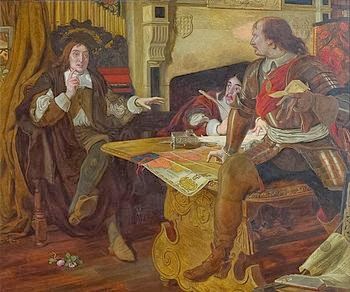
Cromwell is still a hero in the Waldensian Valleys. In medieval times, the Waldensians or Vaudois built Bible schools in remote places in the Cottian Alps. When Catholicism was forced on the Waldensians at the point of a sword, thousands of their women and children were smoked to death, in a mountain cave. This was just one of several brutal military attempts to murder them en masse. At one point, it was only due to the mountains, military ability and Oliver Cromwell that the Vaudois survived. Cromwell intervened politically and raised a public subscription on their behalf which was later confiscated, by Charles II. His wrong actions in Ireland took place in a wider age which many secular historians do not fully understand.
Power and war corrupted Cromwell. He let the execution of Charles 1st go ahead against his conscience and secretly sat with his body all night, regretfully, in the Banqueting House. He took over the Royal apartments of Elizabeth 1st at Whitehall Palace where he died, and lived like a Monarch, in spite of running England as a Republic. He followed the hereditary principle by leaving the Protectorship to his son who wisely saw that he did not have the skills to maintain it. Cromwell was even sorely tempted to award himself the Crown, only holding back, at the last minute.
Power and war corrupted Cromwell. He let the execution of Charles 1st go ahead against his conscience and secretly sat with his body all night, regretfully, in the Banqueting House. He took over the Royal apartments of Elizabeth 1st at Whitehall Palace where he died, and lived like a Monarch, in spite of running England as a Republic. He followed the hereditary principle by leaving the Protectorship to his son who wisely saw that he did not have the skills to maintain it. Cromwell was even sorely tempted to award himself the Crown, only holding back, at the last minute.
It is mystifying to foreigners why England, after the tragic English Civil War, in which families were killing each other on opposite sides (Royalists and Roundheads) reverted to a monarchy in Charles II. The reason handed down in our history lessons, is first, the prohibition of celebrating Christmas, by Cromwell, which the English have always loved. Second, the closure of the theatres and other forms of public entertainment deemed as "fun". The closing of the theatres by the Puritans was following in the teachings of the early Church Fathers, in other words those living under the Roman Empire, not with any actual text in the Bible. The English have to ensure bad weather most of the year. They feel they need their outdoor and indoor pursuits to keep going. They are also key purveyors of theatrical creativity. Sometimes, you can push a people too far.
Cicero states in his masterwork "De Officiis" (Of Duties) which was the second printed book after the Gutenberg Bible in the Renaissance, that politicians devoid of greed for worldly material gain must selflessly govern for all the people or they will bring the entire house down, as Cromwell probably did.
My view is that Oliver Cromwell was a great man with a vision of freedom centuries ahead of his age, who simply became as cruel as all the others, in the end. His extensive legacy, in terms of rights and Parliamentary democracy, endures to this day. He certainly changed the course of our history in that the power of the Monarch passed to the representatives of the people permanently. However, the paucity of knowledge of the Bible today among the general populace, would seriously alarm him.
My view is that Oliver Cromwell was a great man with a vision of freedom centuries ahead of his age, who simply became as cruel as all the others, in the end. His extensive legacy, in terms of rights and Parliamentary democracy, endures to this day. He certainly changed the course of our history in that the power of the Monarch passed to the representatives of the people permanently. However, the paucity of knowledge of the Bible today among the general populace, would seriously alarm him.
Tuesday, 17 December 2013
Solstice of the Ancient World
December is a barest month.
Vegetation lying flat on the meadows.Muddy lanes mirroring pink skies.
The weak world, tipped into dark.
Christmas trees are done up,
Like streetwalkers, waiting for a light.
Listening to the clack of heels
On wet, uneven paving slabs.
This was the old Aegean world.
The psalms of Susa alien to its ears.
No power could overcome, no love,
Could move the hearts of men.
The world was hard December.
Dark dreams on the lapping shores.
Wine songs, respite from the occult
Victory of the moon.
Then a single star rose in the West.
Powers shrank back : a child!
Dominions of the darkness
Aimed to kill him, whispering….
He can make the fevered nights
Wholesome, sweeten dreams.
No power could overcome, no love,
Could move the hearts of men.
The world was hard December.
Dark dreams on the lapping shores.
Wine songs, respite from the occult
Victory of the moon.
Then a single star rose in the West.
Powers shrank back : a child!
Dominions of the darkness
Aimed to kill him, whispering….
He can make the fevered nights
Wholesome, sweeten dreams.
He has power to melt the flint heart,
Pour flesh, make ventricles.
He has power to bless, set free
From evil, the sons of men.
Lift up the bowed and crippled
Trapped in our invisible net.
He can make the World
Turn on its axis, with desire.
Head towards the rising Sun,
Wake from its chains and live...

Pour flesh, make ventricles.
He has power to bless, set free
From evil, the sons of men.
Lift up the bowed and crippled
Trapped in our invisible net.
He can make the World
Turn on its axis, with desire.
Head towards the rising Sun,
Wake from its chains and live...

Subscribe to:
Posts (Atom)